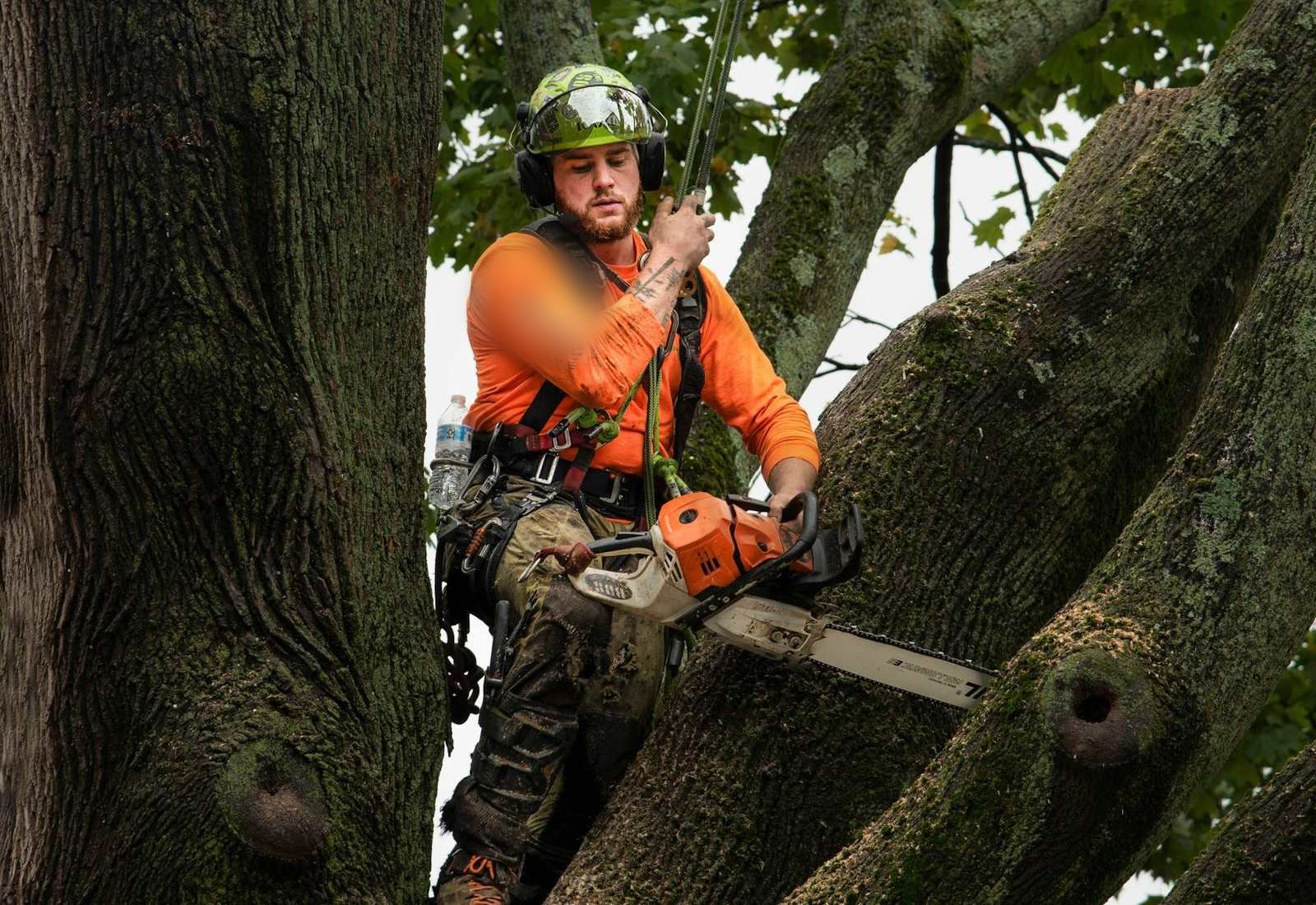
A single bad limb rarely means a tree has to go, and a big healthy-looking tree is not always safe. The International Society of Arboriculture says "there is no such thing as a completely safe tree", and that judging how serious a defect is "is best done by a professional arborist". This page helps you decide who to call and what to ask.
When trimming is usually enough
Texas A&M Forest Service says a tree that is healthy, poses no danger and has no major structural damage usually recovers, and that "A mature shade tree can usually survive the loss of one major limb." ISA lists these as reasons to prune:
- Limbs that interfere with utilities or structures.
- Limbs that obstruct streets or sidewalks.
- Dead, storm-damaged, weak or decayed limbs.
- Diseased or insect-infested limbs.
Cabling and bracing can support weak branches, but ISA says those supports "are not guarantees against failure".
When removal is the safer call
The Forest Service leans toward removal when a tree is weakened by disease, has a split trunk, or has lost more than half its crown, because with less than half left it "may not be able to produce enough foliage". It adds that a tree in the wrong place, like a large tree under a power line, may be best removed now. ISA recommends an arborist's help when a tree is:
- Dead, dying or an unacceptable risk.
- An obstruction that pruning can't correct.
- Crowding and harming more desirable trees.
- In the way of new construction.
A red oak that has died of oak wilt is its own case. The Forest Service says to cut and dispose of it soon after discovery, and the oak wilt page explains why.
ISA's tree risk checklist
ISA says that if you answer yes to any of these, the tree should be examined by an ISA Certified Arborist:
- Are there large dead branches, or detached, hanging branches?
- Have any branches fallen from the tree?
- Is there loose bark on the trunk?
- Are there cracks or splits in the trunk or where branches attach?
- Are there cavities or rotten wood along the trunk or in major branches?
- Are mushrooms growing at the base or under the tree?
- Has the area been altered by construction, soil changes, lawn or pavement?
- Are the leaves an unusual yellow, or smaller than normal?
- Has the tree been topped or heavily pruned?
Two more worth a close look: cracks or separations in the soil near the roots, especially if the tree is leaning, and a trunk that splits into two main stems, which ISA says can often be a failure point.
Topping is not a middle ground
Someone may offer to "just take the top out" as a cheaper way to reduce the risk. ISA calls topping "perhaps the most harmful tree pruning practice known". It can remove 50 to 100 percent of the leaf-bearing crown. The new shoots are weakly attached and prone to breaking, so "risk of limb failure has now increased". It also goes by heading, tipping, hat-racking and rounding over.
When a tree truly has to be smaller, ISA describes pruning a limb back to a side branch at least one-third the diameter of the limb being removed. It also says that sometimes the best answer is to remove the tree and plant something better suited to the spot.
What changes the answer in Killeen
- Oaks. Either job wounds the tree, and the Forest Service says to avoid wounding oaks from February through June. Dates can decide between now and later unless there is a real safety issue.
- Power lines. ISA says never to try removing tree parts near lines, and Texas law sets a six-foot limit around high voltage overhead lines. For trees near street lights, Killeen's Code Enforcement page points to Oncor's contact center at 888-313-6862.
- A neighbor's limbs. The Texas State Law Library says a neighbor can generally trim limbs to the property line, but "could be sued if they injure the tree or other property".
- Which trees. We found no tree census for Killeen. The closest local list is the species recommended in the city's older landscaping rules, which include cedar elm, live oak, pecan, Shumard oak and Texas red oak.
Who should make the call
A company that sells removals has a reason to recommend one. ISA says to get more than one estimate, and you can look for an ISA credential with its directory. For general tree questions that are not about hiring, try the Bell County AgriLife Extension office. The questions page covers the rest.
Phone line opening soon
Allow us to connect you to a local pro.
Sources
- International Society of Arboriculture, Recognizing Tree Risk (PDF, 2021)
- Texas A&M Forest Service, Can My Tree Be Saved?
- International Society of Arboriculture, Why Hire an Arborist? (PDF, 2021)
- Texas A&M Forest Service, How to Identify and Manage Oak Wilt in Texas (PDF, 2024 revision)
- International Society of Arboriculture, Why Topping Hurts Trees (PDF, 2021)
- Texas Health and Safety Code, section 752.004 (free copy on Public.Law)
- City of Killeen, Code Enforcement page
- Texas State Law Library, Neighbor Law guide, Trees (last updated September 1, 2026)
- City of Killeen, Landscaping Regulations for lots platted before August 18, 2020 (Chapter 8, Article VI, PDF on the city site)
- TreesAreGood.org, Find an Arborist directory (listings are voluntary)
- Texas A&M AgriLife Extension, Bell County office
Read on 2026-11-04. External pages can change.